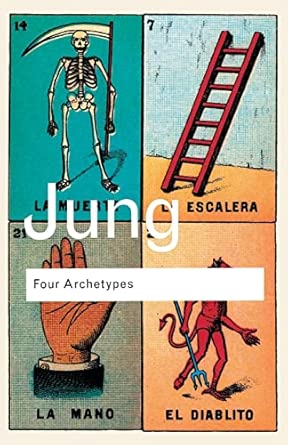
Synopsis
The concept of the archetype is crucial to jung's radical interpretation of the human mind. Jung believed that every person partakes of a universal or collective unconscious that persists through generations. The origins of the concept can be traced to his very first publication in 1902 and it remained central to his thought throughout his life. As well as explaining the theoretical background behind the idea, in four archetypes jung describes the four archetypes that he considers fundamental to the psychological make-up of every individual: mother, rebirth, spirit and trickster.
Four Archetypes Quiz
Free 15-question quiz — how well do you know it?
Readers of this book also read
 Signs Taken for Wonders: On the Sociology of Literary FormsFranco Moretti
 Rites and Symbols of InitiationMircea Eliade
 Dream Analysis 1: Notes of the Seminar Given in 1928-30C.G. Jung
 The Red Book: Liber NovusC.G. Jung
 Tools for ConvivialityIvan Illich
 Clara: or, On Nature's Connection to the Spirit WorldFriedrich Wilhelm Joseph Schelling
 Vita Contemplativa: In Praise of InactivityByung-Chul Han
 The Agony of ErosByung-chul Han
 Madness and CivilizationMichel Foucault
 The Sublime Object of IdeologySlavoj Žižek
 Memories, Dreams, ReflectionsCarl G. Jung
 Aspects of the FeminineC.G. Jung
Track it on perLibre
Keep the books you read and the movies and shows you watch in one place. Free.